Buying Guides
How to Choose an Automated Stud Welding Machine
Stud size, panel envelope and stud count decide which automated stud welding machine fits. Here is how to match the H3 series to your panels.
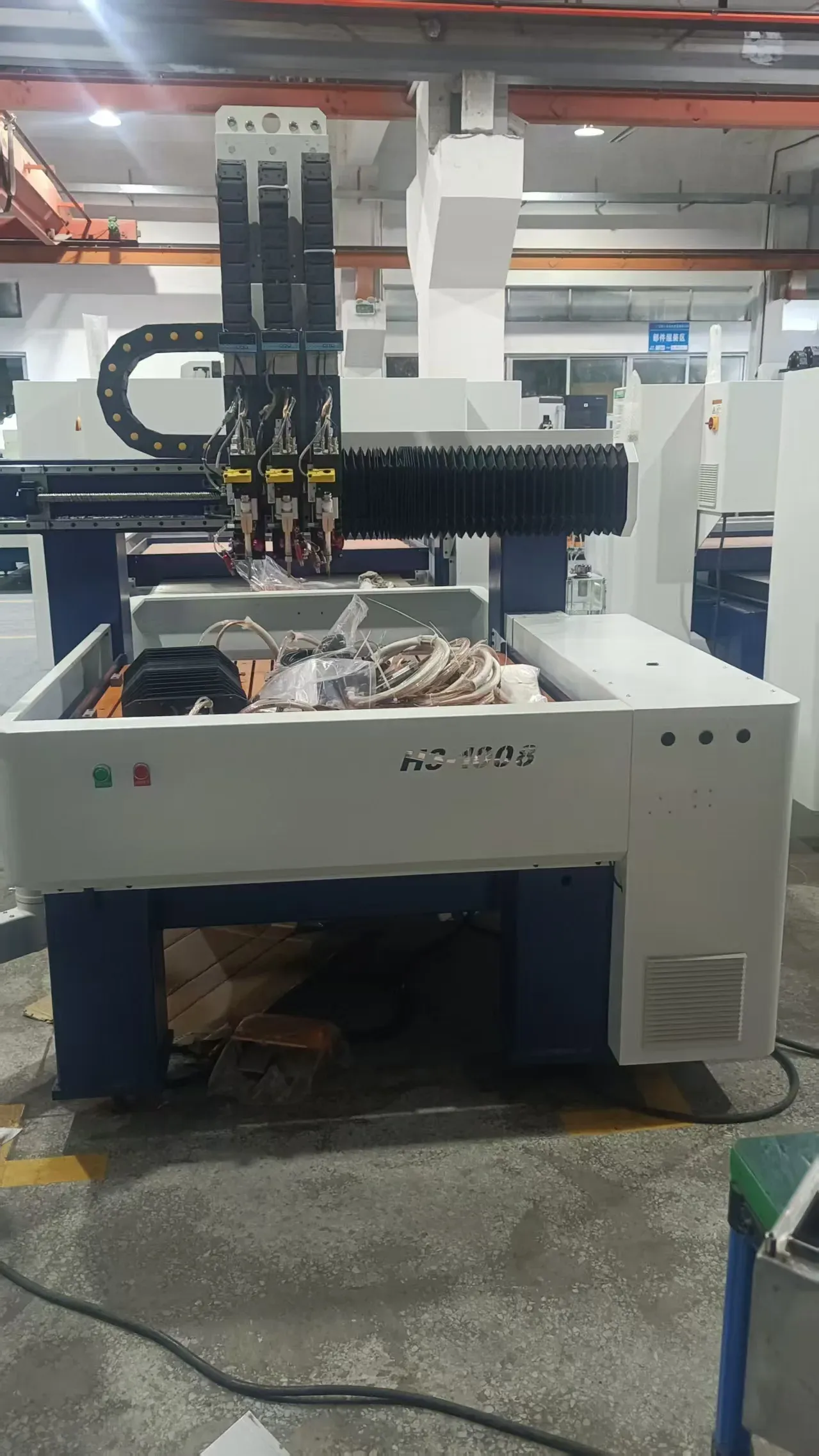
Stud welding is one of the last manual steps in many sheet metal shops. An operator marks the panel, positions each stud by eye, and welds it one at a time — which is why stud position drifts across a batch and why mixed stud sizes slow the line down. This guide works through the decisions that change the answer — stud range, panel envelope, stud count and the drawing workflow — before you choose an automated stud welding machine, using the four models of the LR AUTOMATION H3 series as the worked example.
Start With the Stud, Then the Panel
Two limits decide whether an automated stud welder fits at all. The first is the stud itself: the H3 series covers stud diameters from 3 to 8 mm and stud lengths from 6 to 30 mm. A part that uses studs outside that window needs a different process, not a different model.
The second is the panel: the four models cover machining ranges from 1000 x 2000 mm to 2000 x 4000 mm (H3-1020 through H3-2040), so size on the largest panel you actually run and leave clamping clearance around it.
How Many Studs, and How Many Variants
For a stud welding machine for sheet metal, throughput is published as 15 to 30 studs per minute. That figure matters on panels with dozens of studs: the gap between welding one at a time and welding on a fixed pattern is what decides whether the machine earns its place.
Variants matter as much as count. The H3 carries three welding guns and three feeders, so a part that uses several stud specifications does not need three separate runs. If your panels mix M5 and M8 studs, or short and long studs, this is the specification to check first.
The control imports DXF drawings and is specified to be operated by general workers, so stud positions come from the drawing rather than from an operator marking the panel. Welding process formulas are saved in the control, which is what keeps the process repeatable from shift to shift.
Accuracy and Stud Verticality
Machining accuracy is +/-0.1 mm across the series. Two design details support consistency: the welding torch is kept perpendicular to the work table, so each stud stands square to the panel surface; and the welding voltage is adjusted steplessly over a bus-type control, so a saved process formula can be held rather than re-tuned by each operator.
What Changes Across the Four Models
Shared specification: Z-axis travel 300 mm; movement speed 1000 mm/s; welding efficiency 15 to 30 studs per minute; machining accuracy +/-0.1 mm; stud diameter 3 to 8 mm; stud length 6 to 30 mm; one stud welding machine, three welding guns and three feeders; total power 7.5 kW. A laser is available as an option (one set).
What the model changes: the working envelope — and the machine size and weight that follow from it. Check the floor, the lifting route and the bay against the envelope you choose before committing to the largest model.
When an Automated Stud Welder Is Not the Answer
It fits when studs repeat in patterns and position consistency matters. It is not the machine for every shop:
• Studs outside the range: diameters beyond 3 to 8 mm or lengths beyond 6 to 30 mm are outside the H3 specification.
• Panels larger than the envelope: the biggest model covers 2000 x 4000 mm; larger parts need a different arrangement.
• Low volume: a handful of studs on an occasional panel rarely pays back the setup and handling time.
• Other welding work: this machine places studs; it does not replace seam welding, spot welding or structural welding of the assembly.
How to Specify: A Practical Checklist
• Stud list: every diameter and length on the part, and how many of each.
• Pattern drawing: a DXF or dimensioned drawing of the stud positions.
• Panel envelope: the largest and the most awkward panel, not the average one.
• Batch profile: how often the pattern repeats and how many variants share the machine.
• Downstream step: whether the panel goes straight to assembly after studs, and what handling that implies.
FAQ
What stud range does the H3 cover? Diameters from 3 to 8 mm and lengths from 6 to 30 mm, on all four models.
Can it weld different stud sizes on one panel? Yes. Three welding guns and three feeders allow different specifications to be placed without separate runs, provided each is inside the stud range above.
Do operators need to program it? No. The control imports DXF drawings and is specified for general workers; welding process formulas are stored so the same setting is reused.
How fast is it? Published welding efficiency is 15 to 30 studs per minute; the real number depends on the pattern, stud size and handling between panels.
What accuracy should I expect? Machining accuracy is +/-0.1 mm. The torch-to-table perpendicularity is what keeps the stud square on the panel.
Which model fits my panels? Match the envelope first — 1000 x 2000, 1300 x 2500, 2000 x 3000 or 2000 x 4000 mm — then confirm that the machine's size and weight suit your bay and lifting route.
What to Send for a Configuration Recommendation
Send the stud list (diameters, lengths, quantities), the stud pattern drawing, the largest panel and the batch profile. Our team will confirm which H3 model fits the envelope and whether three guns cover the variants on the part — a specification you can check against your own drawings before committing.