Buying Guides
Fitting a Bending Follow-up Support to Your Press Brake: Setup, Mounting Window and Daily Operation
A bending follow-up support only pays back if it fits the press brake in front of it. How to check the mounting window, set the table height and run the F/EH series day to day.
1. Start with the mounting window, not the lift weight
A bending follow-up support stands in front of the press brake and carries the sheet through the bend. Lift weight decides which model can hold the sheet, but three other dimensions decide whether the unit can be set up against a given brake at all: the minimum table height (A), the front-wall panel avoidance (B), and the height automatic adjustment range. If the brake's table height and frame fall outside these figures, the unit cannot be fitted to that brake, however much lift it has. Check the window first, then the lift.
Model family | Minimum table height (A) | Height auto-adjustment | Front-wall avoidance (B) | Table width |
|---|---|---|---|---|
F890 | 950 mm | 73 mm | 270 mm | 700 mm |
EH10–EH30, 90° models | 870 mm | 150 mm | 240 mm | 700 mm |
EH10–EH30, 30° models | 1050 mm | 80 mm | 190 mm | 700 mm |
EH50, 90° model | 900 mm | 150 mm | 240 mm | 780 mm |
EH50, 30° model | 1080 mm | 80 mm | 190 mm | 780 mm |
The 30° models sit higher and adjust less, because they are built to follow bends down to a 30° minimum angle with double-fold compound tooling. The 90° models sit lower with a wider adjustment range. Send the brake's table height and frame dimensions with the enquiry, and the fit can be checked against this table before anything is ordered.
2. Positioning the unit
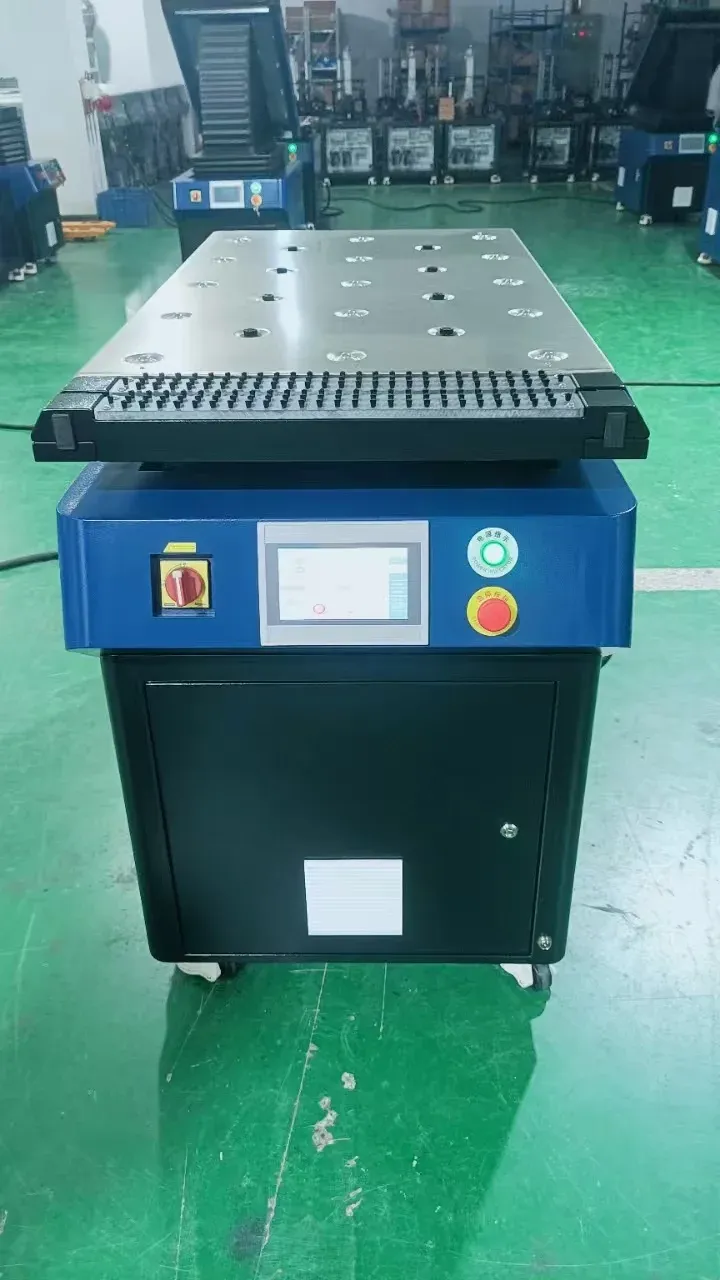
The unit stands on a mobile base with Fuma wheels, so it is rolled to the brake that is bending large sheets rather than fixed to one machine. Two cables come as standard: the power cable and the displacement sensor cable. The sensor reads the bending machine's motion, and the follower's own control system matches the table movement to it — linkage by measurement, not by wiring into the brake. The press brake is not modified.
Table height and installation distance are set as parameters in the controller, which adjusts them to match the host brake. That is the whole installation: position the unit, set the two parameters, connect the sensor cable. There is no mechanical rebuild of the brake and no change to its control side.
3. Matching the table to the brake
Two things have to agree between the follower and the brake: the table height and the direction of the bend.
- Table height. The follower's table adjusts automatically to the working height of the press brake, within the adjustment range in the table above. Once set, the sheet leaves the brake table and meets the follower table at the same height, so it is supported instead of sagging at the far end.
- Up-acting or down-acting. The 90° models fit up-acting press brakes. The 30° models fit both up-acting and down-acting press brakes, and they are the models that carry the compound mold function for double-fold work. If the shop runs a down-acting brake, the choice is a 30° model.
4. The support surface: how the sheet moves without marking
The sheet does not sit on a bare steel table. The worktable combines universal ball steel balls with brush support, so the sheet slides onto the table and rides on rolling contact through the cycle instead of dragging across a fixed surface. The extension rod that reaches out under long sheets carries a support brush plate of its own. That is what keeps a finished surface free of the scratches that manual handling leaves behind.
For sheets that tend to slide on a ball table, sucker or magnet holding is available as an option on all nine models. A 2000 mm width extension is also optional on all models, for wide panels that need support across their width as well as their length.
5. Running a bend
Operation is from buttons and a touch screen on the unit. The 30° models also come with a foot switch as standard. Once the bend starts, the follow-up device moves in step with the plate: as the sheet rises, the support table rises with it, so the sheet stays supported for the whole bend. The operator does not hold the sheet by hand, and the sheet is never bent while being held at the wrong angle — which is the deformation that manual support causes.
6. One unit, several brakes
Because the linkage comes from the follower's own sensor and its own control system, the unit is not tied to one press brake. One follow-up device can be used with multiple bending machines: roll it to the brake running long parts that day, set the table height and installation distance for that brake, and run. For extra-long sheets, two-machine linkage is available as an option, so two followers work together on the same part.
7. What to send before a quote
Send these items and the model and fit can be confirmed without a long back-and-forth:
- Press-brake brand, model and tonnage, and whether it is up-acting or down-acting.
- Press-brake table height and frame dimensions, to check against the mounting window.
- Part material and thickness, part size, bending length and sheet weight.
- Part drawings, and the minimum bend angle for box work or deep profiles.
8. Common questions
- Does fitting it modify my press brake? No. The unit has its own control system and its own displacement sensor, so linkage is achieved by sensing the brake's motion. Nothing is wired into or changed on the brake.
- What if my brake is down-acting? Choose a 30° model (EH1030, EH2030, EH3030 or EH5030). The 90° models fit up-acting brakes only.
- How do I know it fits before ordering? Send the brake's table height and frame dimensions. They are checked against the minimum table height, front-wall avoidance and height adjustment figures for the model.
- Can I move it between brakes? Yes. The unit stands on a mobile base. Set the table height and installation distance parameters for the brake it is moved to.
- What if the sheet slides on the ball table? Sucker or magnet holding is available as an option on all models, and the extension rod carries its own brush support plate.
- Does it work for box work and deep bends? The 30° models follow bends down to a 30° minimum angle and carry the compound mold function for use with a double-fold compound die.
Contact
Lazy Automation — Guangdong Lazy Automatic Equipment Co., Ltd, Dongguan, China.
Email: yuanrongbing8@gmail.com · Tel: +86 139 0269 5283 · www.lazy-auto.com