Buying Guides
Bending Deep Boxes and Extra-Long Sheets: What the 30° EH Models Are Built For
Flat bending is covered by the 90° models. Deep boxes, double-fold profiles and extra-long sheets need the 30° EH models, compound tooling and two-machine linkage — how to tell which job needs what.
1. The jobs a standard 90° follower cannot do
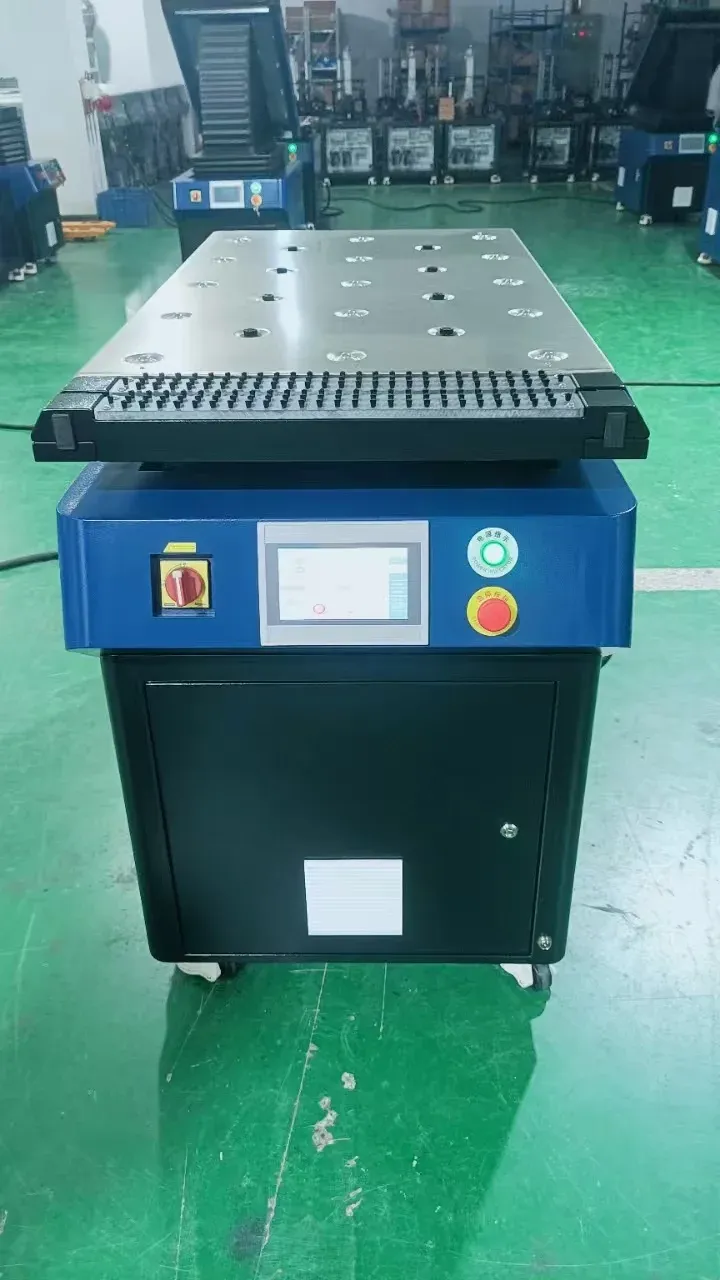
A 90° bending follow-up support covers flat sheet work: the sheet bends up to a right angle and the table follows it. Three kinds of job fall outside that range.
First, deep boxes and profiles bent past 90°. Once the bend goes below a right angle, a 90° follower can no longer follow the sheet through the full bend. Second, double-fold work, where the same part is bent twice with compound tooling. Third, sheets so long that one support unit cannot carry the full overhang, even with its extension rod out.
These are not edge cases for enclosure, cabinet and electrical-box shops. They are the daily work. The 30° models of the F890 / EH series exist for exactly these jobs.
2. The 30° models: what changes
Four models carry the 30° minimum bending angle: EH1030, EH2030, EH3030 and EH5030. They differ from the 90° models in four ways that matter on the shop floor.
Model | Lift (kg) | Table length (mm) | Extension length (mm) | Minimum bending angle | Total power |
|---|---|---|---|---|---|
EH1030 | 100 | 1280 | 3200 | 30° | 4 kW |
EH2030 | 200 | 1280 | 3200 | 30° | 6 kW |
EH3030 | 300 | 1280 | 3200 | 30° | 8 kW |
EH5030 | 500 | 1280 | 3200 | 30° | 10 kW |
- Compound mould function. The 30° models carry the compound mould function for use with a double-fold compound die. The 90° models do not.
- Down-acting brakes. The 30° models fit both up-acting and down-acting press brakes. The 90° models fit up-acting brakes only. If the shop runs a down-acting brake, the choice is a 30° model whatever the part looks like.
- Foot switch as standard. The 30° models come with a foot switch as standard; the operator starts the follow-up from the floor while handling the sheet.
- A higher, narrower mounting window. The 30° models sit higher — minimum table height 1050 mm (1080 mm on the EH5030) against 870–950 mm for the 90° models — and adjust less, 80 mm against 150 mm on the EH 90° models. Check the brake's table height against these figures before ordering, the same way as for any follower.
Lift is chosen the same way as for the 90° models: by sheet weight and bending length, remembering that a light sheet with a long overhang can need more support than a heavier sheet with a short one.
3. Double-fold work and the compound mould function
Double-fold profiles are bent twice: the first bend forms one face, the second folds the edge back on itself. The sheet has to stay supported and in position through both bends, and the follower has to follow the sheet down to the smaller angle of the second fold.
That is what the compound mould function is for. The 30° model follows the sheet to a 30° minimum angle while working with the double-fold compound die, so the part is supported through both folds instead of being held by hand for the second one. Send the part drawing and the minimum bend angle with the enquiry: the angle decides whether a 30° model is needed, and the lift and table length decide which one.
4. Extra-long sheets: two-machine linkage
One follower carries a sheet up to its extension length — 3200 mm on the EH models. For sheets longer than that, two-machine linkage is available as an option on all nine models: two followers work together on the same part, linked so they move in step.
Two-machine linkage is also the answer when a single unit could carry the weight but not the length. The two units share the sheet between them, so neither end sags and the bend stays even across the full length. The units stand on mobile bases with Fuma wheels, so they are rolled into position for the job and moved on afterwards.
5. Wide sheets and sheets that slide
Length is not the only dimension that needs support. A 2000 mm width extension is available as an option on all nine models, for wide panels that need support across their width as well as their length.
Some sheets slide on a plain table. The worktable combines universal ball steel balls with brush support, so the sheet rides on rolling contact instead of dragging across a fixed surface, and the extension rod carries a support brush plate of its own. For sheets that still tend to slide, sucker or magnet holding is available as an option on all nine models.
6. 90° or 30°: a short comparison
| 90° models (F890, EH1090/2090/3090/5090) | 30° models (EH1030/2030/3030/5030) |
|---|---|---|
Minimum bending angle | 90° | 30° |
Compound mould / double-fold function | No | Yes |
Foot switch | Not standard | Standard |
Press-brake type | Up-acting only | Up-acting and down-acting |
Minimum table height | 870–950 mm | 1050–1080 mm |
Height auto-adjustment | 73–150 mm | 80 mm |
Two-machine linkage | Optional | Optional |
Sucker / magnet holding | Optional | Optional |
2000 mm width extension | Optional | Optional |
If the work is flat bending on an up-acting brake, a 90° model is enough. If any part needs a bend below 90°, a double fold, or a down-acting brake, the job needs a 30° model.
7. What to send before a quote
Send these items and the model can be confirmed without a long back-and-forth:
- Part material and thickness, part size, and the minimum bend angle.
- Bending length, sheet weight, and whether any part is a double-fold profile.
- For extra-long sheets, the full sheet length, to check whether two-machine linkage is needed.
- Press-brake brand, model and tonnage, whether it is up-acting or down-acting, and the table height.
- Part drawings.
8. Common questions
- When do I need a 30° model instead of a 90° model? When any bend goes below 90°, when the part needs a double fold with compound tooling, or when the press brake is down-acting. The 90° models fit up-acting brakes only.
- Can two followers work on one sheet? Yes. Two-machine linkage is available as an option on all nine models, so two units move in step on the same part.
- What if my sheet is wider than the table? A 2000 mm width extension is available as an option on all models.
- What if the sheet slides on the ball table? Sucker or magnet holding is available as an option on all models, and the extension rod carries its own brush support plate.
- Does fitting a 30° model modify my press brake? No. Like the 90° models, it has its own control system and its own displacement sensor, so linkage is achieved by sensing the brake's motion. Nothing is wired into or changed on the brake.
- Can one unit serve several press brakes? Yes. The unit stands on a mobile base. Set the table height and installation distance parameters for the brake it is moved to.
Contact
Lazy Automation — Guangdong Lazy Automatic Equipment Co., Ltd, Dongguan, China.
Email: yuanrongbing8@gmail.com · Tel: +86 139 0269 5283 · www.lazy-auto.com